
Why Gluconate-Based Nutrition Works Better for Crops
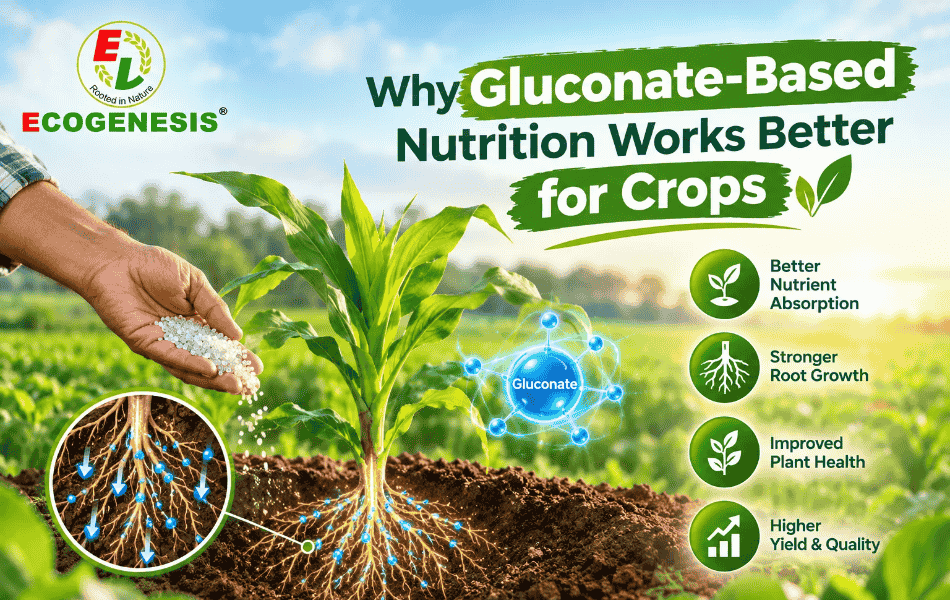
Why Gluconate-Based Nutrition Works Better for Crops
Modern agriculture is increasingly focused on nutrient-use efficiency, nutrient availability, and better crop performance rather than simply applying more fertilizer. One approach gaining attention is gluconate-based plant nutrition, where mineral nutrients are supplied in association with gluconate.
Gluconate-based formulations are used in plant nutrition products because gluconate can function as a complexing or chelating component for certain mineral nutrients. The objective is to keep nutrients in a form that can be effectively delivered to the plant through appropriate application methods.
What Is Gluconate-Based Plant Nutrition?
Gluconate-based plant nutrition refers to formulations in which nutrients such as calcium, zinc, iron, manganese, copper, or other minerals are associated with gluconate.
Gluconate is derived from gluconic acid, an organic acid related to glucose metabolism. In agricultural formulations, it can be used to create nutrient complexes designed for plant nutrition.
Unlike conventional fertilizer thinking, which often focuses primarily on the quantity of nutrient applied, gluconate-based nutrition emphasizes the relationship between nutrient formulation, availability, application, and plant uptake.
Why Nutrient Availability Matters
A fertilizer can contain the required nutrient without that nutrient necessarily being readily available to the plant.
Nutrient availability can be influenced by:
-
Soil pH
-
Soil texture
-
Organic matter
-
Moisture
-
Temperature
-
Nutrient interactions
-
Root activity
-
Application method
-
Nutrient formulation
For example, nutrients such as zinc and iron can become less available under certain soil conditions. Therefore, improving the way a nutrient is formulated and delivered can be an important part of a modern crop nutrition strategy.
1. Supports Efficient Nutrient Delivery
One of the main reasons gluconate-based formulations are attracting attention is their focus on nutrient delivery.
Gluconate can associate with mineral ions and help formulate nutrients in a form suitable for agricultural applications.
The practical benefit depends on the specific nutrient, formulation, crop, application method, and environmental conditions. Therefore, gluconate should not be viewed as a universal solution for every nutrient deficiency.
2. Useful for Micronutrient Management
Micronutrients are required in relatively small quantities, but they perform important physiological functions.
These include:
-
Zinc
-
Iron
-
Manganese
-
Copper
-
Boron
-
Molybdenum
Gluconate-based formulations can be used in products designed to supply certain micronutrients.
For crops such as soybean, cotton, grapes, pomegranate, vegetables, cereals, and fruit crops, micronutrient management can become especially important when soil conditions restrict nutrient availability or when crop demand increases during specific growth stages.
3. Helps Address Nutrient Availability Challenges
A major challenge in plant nutrition is that nutrients applied to soil do not always remain equally available to plants.
For example, soil pH can strongly influence the availability of several micronutrients. High-pH soils may reduce the availability of nutrients such as iron and zinc.
Gluconate-associated nutrient formulations are designed with nutrient availability and delivery in mind, making them an option for certain crop nutrition programs.
However, the actual effectiveness should always be evaluated according to the specific formulation and field conditions.
4. Suitable for Foliar Nutrition
Foliar nutrition provides nutrients directly to plant leaves rather than relying entirely on root uptake.
When a micronutrient product is specifically formulated and labeled for foliar application, it can be used when rapid nutrient supplementation is required.
Gluconate-based formulations can be incorporated into foliar nutrient products because of their formulation characteristics.
Foliar nutrition can be useful when:
-
A nutrient deficiency has been identified.
-
Soil conditions restrict nutrient availability.
-
Crop demand is temporarily high.
-
A specific growth stage requires additional nutritional support.
-
Root uptake is limited by environmental conditions.
Foliar spraying should always follow the product label regarding dose, water volume, crop stage, and compatibility.
5. Supports Stage-Based Crop Nutrition
Plants do not have the same nutrient requirements throughout their entire life cycle.
Nutritional priorities change between:
Germination → Vegetative Growth → Flowering → Fruit/Pod/Boll Development → Maturity
For example, zinc may be important during early growth, while boron can become particularly relevant around reproductive development.
A gluconate-based nutrient program can therefore be incorporated into a stage-specific nutrition strategy, rather than applying the same fertilizer throughout the crop cycle.
6. Can Complement Balanced Fertilization
Gluconate-based plant nutrition should not replace the fundamentals of crop nutrition.
Plants still require:
Macronutrients
-
Nitrogen
-
Phosphorus
-
Potassium
Secondary nutrients
-
Calcium
-
Magnesium
-
Sulfur
Micronutrients
-
Zinc
-
Iron
-
Manganese
-
Boron
-
Copper
-
Molybdenum
-
Chlorine
-
Nickel
The objective is to maintain balanced plant nutrition.
Gluconate-based micronutrients can complement a broader fertilizer program when a particular nutrient is required.
7. Why Conventional Nutrient Application May Not Always Be Enough
Traditional fertilizer programs can successfully supply crops with essential nutrients. However, nutrient application alone does not guarantee that every nutrient will be efficiently available at the root or leaf surface.
Several factors can interfere with nutrient availability:
-
High soil pH
-
Excessive rainfall
-
Waterlogging
-
Drought
-
Nutrient antagonism
-
Poor root development
-
Low organic matter
-
Improper fertilizer placement
This is why modern plant nutrition increasingly considers formulation and nutrient-use efficiency, rather than only fertilizer quantity.
Gluconate-Based vs Conventional Nutrient Thinking
|
Factor |
Conventional Approach |
Gluconate-Based Approach |
|
Primary focus |
Nutrient quantity |
Nutrient delivery and availability |
|
Micronutrient use |
Soil or foliar application |
Can be formulated for soil/foliar use |
|
Nutrient formulation |
Depends on fertilizer type |
Nutrient associated with gluconate |
|
Crop-stage management |
Often application-based |
Can support stage-specific nutrition |
|
Main objective |
Supply nutrients |
Improve practical nutrient delivery |
|
Role in farming |
Core fertilizer program |
Complementary nutrition strategy |
This comparison does not mean conventional fertilizers are ineffective. Different nutrient sources have different agronomic roles, and their suitability depends on the crop, soil, nutrient, and application method.
Gluconate-Based Nutrition in Different Crops
Soybean
Soybean requires balanced nutrition throughout vegetative and reproductive development.
Gluconate-based micronutrients may be considered where nutrients such as zinc, iron, or manganese are required.
During flowering and pod development, nutrient management becomes particularly important for maintaining crop health.
Cotton
Cotton has a long growing season with changing nutritional requirements.
Micronutrients such as zinc and boron can be important during vegetative and reproductive stages.
A stage-based nutrition program can help growers evaluate whether additional micronutrient supplementation is required.
Grapes
Grapes have several important developmental stages, including:
-
New growth
-
Flowering
-
Fruit set
-
Berry development
-
Berry maturation
Micronutrient requirements can change across these stages, making crop monitoring important.
Pomegranate
Pomegranate nutrition requires attention to vegetative growth, flowering, fruit set, and fruit development.
Balanced micronutrient management can be incorporated into a broader nutrition strategy based on soil and crop conditions.
How to Use Gluconate-Based Plant Nutrition Effectively
Using a gluconate-based product effectively starts with identifying the actual nutritional requirement.
1. Test the soil
Soil testing can provide information about nutrient availability and help identify potential deficiencies.
2. Monitor the crop
Look for changes in:
-
Leaf color
-
Plant growth
-
Internode development
-
Flowering
-
Fruit or pod formation
-
Overall crop vigor
3. Identify the nutrient requirement
Do not assume that every symptom is caused by a micronutrient deficiency.
Similar symptoms can result from:
-
Water stress
-
Root damage
-
Disease
-
Pest infestation
-
Soil pH problems
-
Macronutrient deficiency
4. Select the appropriate product
Choose a formulation based on:
-
Nutrient requirement
-
Crop
-
Growth stage
-
Application method
-
Nutrient concentration
-
Product label
5. Apply at the recommended dose
More fertilizer does not automatically produce better results.
Overapplication can cause nutrient imbalance, phytotoxicity, or unnecessary input costs.
The Future of Efficient Plant Nutrition
Agriculture is moving toward a more precise approach to nutrient management.
Farmers increasingly want solutions that address:
What nutrient does the crop need?
When does the crop need it?
How should it be applied?
How efficiently can the plant access it?
This is where gluconate-based plant nutrition can become part of a broader strategy focused on nutrient-use efficiency and whole-plant nutrition.
The goal is not simply to apply more fertilizer. The goal is to provide the right nutrient, in the right formulation, at the right crop stage, and at the appropriate rate.
Frequently Asked Questions
What is gluconate-based plant nutrition?
Gluconate-based plant nutrition uses formulations in which mineral nutrients are associated with gluconate. These products are designed to provide nutrients through appropriate agricultural application methods.
Is gluconate a fertilizer?
Gluconate itself is not a complete fertilizer. In agriculture, it can be used as part of formulations that deliver specific mineral nutrients.
Is gluconate-based nutrition suitable for all crops?
Gluconate-based products can be developed for different crops, but their suitability depends on the nutrient, formulation, crop stage, application method, and label recommendations.
Can gluconate-based nutrients be used as foliar sprays?
Some products are specifically formulated for foliar application. Always check the product label for crop-specific dosage, timing, and compatibility.
Does gluconate replace NPK fertilizer?
No. Gluconate-based micronutrient products should generally be considered part of a balanced nutrition program rather than a replacement for essential macronutrients such as nitrogen, phosphorus, and potassium.
Conclusion
Gluconate-based plant nutrition represents a nutrient-delivery approach that focuses on more than simply applying minerals to the crop.
By combining appropriate nutrient formulation with soil testing, crop-stage monitoring, balanced fertilization, and correct application practices, farmers can build a more targeted crop nutrition program.
The key principle is simple: efficient plant nutrition begins with understanding nutrient availability and crop requirements—not simply increasing fertilizer application.
For modern agriculture, this shift toward nutrient efficiency, targeted supplementation, and whole-plant nutrition can play an important role in developing more precise and sustainable crop nutrition practices.