
Gluconate vs EDTA Chelates: Which Is Better for Indian Crops?
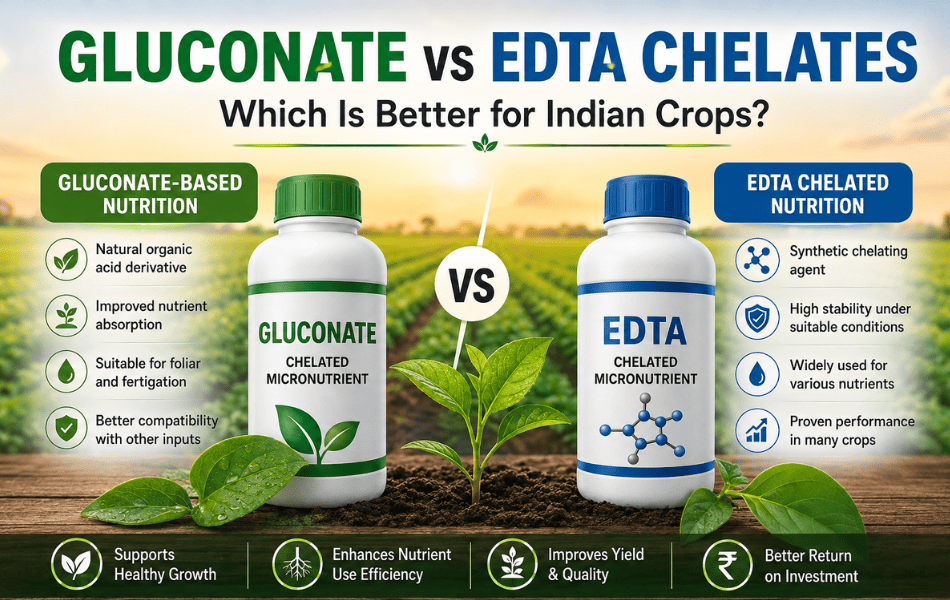
Gluconate vs EDTA Chelates: Which Is Better for Indian Crops?
When farmers need to correct a micronutrient deficiency, choosing the right fertilizer formulation can be challenging. The comparison of gluconate vs EDTA chelated fertilizer is becoming increasingly relevant because both formulations are used to supply important nutrients such as zinc, iron, manganese, copper, calcium, and other minerals. However, gluconate and EDTA are not the same type of chemistry, and neither should automatically be considered better for every crop or farming condition.
The right choice depends on several factors, including crop type, nutrient deficiency, soil pH, irrigation water, application method, growth stage, nutrient concentration, and product formulation. Indian farmers face particularly diverse conditions, from alkaline and calcareous soils to black cotton, alluvial, red, and sandy soils. Because nutrient availability changes with soil and environmental conditions, a fertilizer that performs well in one field may not deliver the same results in another.
This guide explains the difference between gluconate vs EDTA chelates, how each works, their advantages and limitations, and how farmers can select the right micronutrient formulation for Indian crops.
What Is the Difference Between Gluconate and EDTA Chelates?
The easiest way to understand gluconate vs EDTA fertilizer is to recognize that they represent different approaches to mineral nutrient formulation.
EDTA stands for ethylenediaminetetraacetic acid. It is a synthetic chelating agent capable of binding certain metal ions such as zinc, iron, manganese, and copper. This binding can help keep nutrients in a soluble and available form under suitable conditions.
Gluconate, on the other hand, is associated with gluconic acid and is used to formulate mineral nutrients such as zinc gluconate, calcium gluconate, magnesium gluconate, and other nutrient forms depending on the product.
These terms should not be treated as interchangeable. A gluconate-based fertilizer should not automatically be described as an EDTA chelate. Similarly, the word “chelated” does not automatically mean that a product will perform better in every soil or crop.
The practical objective is the same: provide the crop with the required nutrient in a useful and effective form.
Gluconate vs EDTA: Quick Comparison
| Factor | Gluconate-Based Nutrition | EDTA-Chelated Nutrition |
|---|---|---|
| Basic approach | Nutrient associated with gluconate | Nutrient bound with EDTA |
| Common nutrients | Zinc, calcium, magnesium and others | Zinc, iron, manganese, copper and others |
| Foliar application | Product-dependent | Commonly used |
| Fertigation | Product-dependent | Suitable products available |
| pH sensitivity | Depends on formulation | Important consideration |
| Nutrient stability | Formulation-dependent | Chelate-dependent |
| Universal winner | No | No |
How Does EDTA Chelation Work?
EDTA chelation is a well-established approach to micronutrient formulation. EDTA can bind with metal ions and form a relatively stable complex. In simple terms, it can act like a protective carrier around the nutrient, helping reduce some unwanted reactions that could otherwise reduce nutrient availability.
This can be particularly useful for micronutrients because they are required in small quantities but are essential for many plant processes. Zinc, iron, manganese, and copper participate in enzyme activity, photosynthesis, metabolism, growth, and reproductive development.
However, EDTA does not work identically for every nutrient or environmental condition. The stability of the nutrient-chelate complex is affected by factors such as soil pH and the particular metal being supplied.
This is why farmers should not assume that every EDTA product is equally effective in every field.
Why Is pH Important for EDTA Fertilizer?
Soil pH can strongly influence micronutrient availability. As pH increases, some nutrients become less available to plants, especially iron and zinc.
EDTA can be useful for several micronutrients, but its stability has limitations at higher pH. For iron nutrition, other chelates such as DTPA or EDDHA may be more suitable under certain alkaline conditions.
University agricultural guidance shows that iron chelate stability differs considerably with pH, with Fe-EDDHA generally maintaining greater stability at high pH than Fe-EDTA.
This is an important lesson for Indian farmers: the best chelate depends on the nutrient and field conditions.
How Does Gluconate-Based Plant Nutrition Work?
Gluconate-based plant nutrition uses mineral nutrients associated with gluconate. Depending on the formulation, products may contain nutrients such as zinc, calcium, magnesium, iron, or other minerals.
One important example is zinc gluconate, which can be used as a zinc source in crop nutrition programs. Zinc is an essential micronutrient involved in several plant processes, including enzyme activity, growth regulation, and development.
Gluconate formulations can be designed for different application methods, including foliar nutrition and, where specifically recommended, fertigation.
However, the presence of gluconate alone does not guarantee superior nutrient absorption. Performance depends on:
- Nutrient concentration
- Product formulation
- Crop
- Application rate
- Application method
- Growth stage
- Water quality
- Soil conditions
- Weather conditions
Therefore, gluconate vs EDTA chelates should be compared using actual crop and product conditions rather than marketing terminology.
Is Gluconate the Same as EDTA Chelation?
No.
Gluconate and EDTA are chemically different approaches to mineral nutrient formulation.
EDTA is a recognized synthetic chelating agent. Gluconate is associated with gluconic acid and is used to form mineral gluconates.
This distinction matters because farmers may see terms such as “chelated,” “gluconate,” “complexed,” or “available nutrient” on fertilizer labels and assume they all mean the same thing.
They do not.
When comparing zinc gluconate vs zinc EDTA, for example, the farmer should look at:
- Actual elemental zinc concentration
- Recommended application rate
- Crop suitability
- Foliar or soil application
- Fertigation compatibility
- Water quality
- Product stability
- Cost per acre
- Field performance
This provides a much more accurate comparison than simply asking which chemical name sounds better.
Gluconate vs EDTA: Which Is Better for Nutrient Absorption?
There is no universal winner.
Nutrient absorption depends on much more than the fertilizer's chemical name.
For foliar applications, factors such as leaf surface, spray concentration, humidity, temperature, formulation pH, and application timing can affect nutrient uptake.
For soil and fertigation applications, additional factors become important:
- Soil pH
- Root-zone conditions
- Soil texture
- Organic matter
- Irrigation water
- Nutrient interactions
- Moisture
- Crop growth stage
An EDTA fertilizer can be an excellent choice under appropriate conditions, while a gluconate formulation may be useful in another situation.
The important question is not:
“Which chemistry is always better?”
Instead, ask:
“Which nutrient formulation is best suited to this crop, deficiency, soil, and application method?”
Gluconate vs EDTA for Foliar Spray
Foliar nutrition is one of the most practical ways to compare different micronutrient formulations.
A foliar spray places the nutrient directly on the plant surface rather than depending entirely on soil-root availability. This can be useful when a crop has a diagnosed micronutrient deficiency or when root-zone conditions are limiting nutrient availability.
Both gluconate-based and EDTA-based micronutrient products can be formulated for foliar application.
Factors to Consider
Before choosing between gluconate and EDTA for foliar spraying, consider:
- Nutrient deficiency
- Crop species
- Crop growth stage
- Elemental nutrient concentration
- Recommended spray concentration
- Leaf characteristics
- Weather
- Water pH
- Compatibility with other products
A product should always be used according to its label and manufacturer's recommendations.
Is Gluconate Better for Foliar Application?
Not automatically.
A suitable gluconate formulation can be useful for foliar nutrition, but its performance must be evaluated based on the particular nutrient and crop.
Likewise, EDTA is not automatically better simply because it is a chelating agent.
The best approach is to compare products using equivalent nutrient doses and the same application conditions.
Zinc Gluconate vs Zinc EDTA
Zinc is one of the most important micronutrients when discussing gluconate vs EDTA fertilizer.
Zinc supports several important plant processes, including enzyme activity, growth regulation, protein metabolism, and reproductive development. Zinc deficiency can result in reduced plant growth, shortened internodes, chlorosis, and poor crop development, although symptoms vary between crops.
Zinc Gluconate
Zinc gluconate provides zinc associated with gluconate and can be used in appropriate crop nutrition formulations.
Recent research has explored zinc gluconate as a foliar nutrient source in crops including rice, wheat, maize, cotton, and tomato. The evidence is promising, but application rate and method remain important factors.
Zinc EDTA
Zinc EDTA supplies zinc in an EDTA-chelated form. It is an established type of micronutrient formulation and can be used in appropriate foliar, soil, or fertigation programs depending on the product.
Which Zinc Source Is Better?
There is no universal answer.
| Factor | Zinc Gluconate | Zinc EDTA |
|---|---|---|
| Zinc source | Zinc associated with gluconate | Zinc chelated with EDTA |
| Foliar use | Suitable formulations available | Commonly used |
| Nutrient delivery | Formulation-dependent | Chelation-dependent |
| pH considerations | Product-dependent | Important |
| Crop response | Product and crop dependent | Product and crop dependent |
| Best choice | Depends on situation | Depends on situation |
For a fair comparison, farmers should compare the same elemental zinc dose, crop stage, application method, and field conditions.
Gluconate vs EDTA for Iron Deficiency
Iron is a special case in micronutrient management because its availability is strongly affected by soil chemistry.
Iron deficiency is particularly common in high-pH and calcareous conditions. Plants may have adequate total iron in the soil but still experience deficiency because the nutrient is present in forms that are difficult for roots to access.
Iron EDTA
Iron EDTA can be useful under appropriate conditions, particularly where soil pH is not excessively high.
Iron DTPA
Iron DTPA generally provides greater stability than Fe-EDTA under some higher-pH conditions.
Iron EDDHA
Iron EDDHA is particularly important for high-pH and calcareous soils because of its stronger stability under alkaline conditions.
Therefore, if a farmer asks:
“Is EDTA the best iron fertilizer for alkaline soil?”
The answer is not necessarily.
The soil pH and severity of the iron problem should be considered before selecting the formulation.
Gluconate vs EDTA for Indian Soils
India has extremely diverse agricultural soils. Farmers may encounter:
-
Black cotton soils
- Alluvial soils
- Red soils
- Sandy soils
- Lateritic soils
- Calcareous soils
- Alkaline soils
Each soil can influence nutrient availability differently.
Black Soil
Black soils can have high clay content and strong nutrient-holding capacity. Depending on location and management, micronutrient availability can become an issue.
Alluvial Soil
Alluvial soils vary significantly in nutrient status depending on location, cropping history, and management.
Calcareous Soil
Calcareous soils contain significant calcium carbonate and often have higher pH. Iron and zinc availability can become important management concerns.
Alkaline Soil
High pH can reduce the availability of several micronutrients. Selecting the right nutrient formulation becomes particularly important.
This means that the best micronutrient fertilizer for Indian crops cannot be determined without considering local conditions.
Gluconate vs EDTA for Fertigation
Fertigation involves supplying nutrients through irrigation water.
This application method introduces additional considerations because the fertilizer interacts with the irrigation water before reaching the root zone.
Before using any gluconate or EDTA product through drip irrigation, check:
- Water solubility
- Irrigation compatibility
- Water pH
- Water hardness
- Nutrient concentration
- Precipitation risk
- Filtration requirements
- Manufacturer recommendations
A fertilizer designed for foliar application should not automatically be used through drip irrigation.
Is EDTA Better for Fertigation?
Suitable EDTA-chelated micronutrients can be valuable in fertigation because chelation can help reduce precipitation and maintain micronutrients in solution under appropriate conditions.
However, product compatibility and water chemistry remain important.
Can Gluconate Be Used Through Drip Irrigation?
Some gluconate-based products may be formulated for fertigation, but this is product-specific.
Farmers should always confirm the product label and technical recommendation before injecting it into an irrigation system.
Gluconate vs EDTA for Different Indian Crops
Different crops have different nutrient requirements.
| Crop | Important Nutritional Considerations |
|---|---|
| Cotton | Zinc, iron, magnesium and balanced micronutrients |
| Soybean | Zinc, iron and overall balanced nutrition |
| Maize | Zinc is particularly important |
| Wheat | Zinc and iron management |
| Rice | Zinc management can be important |
| Tomato | Calcium, iron, zinc and other micronutrients |
| Chilli | Zinc, calcium, boron and balanced nutrition |
| Grapes | Zinc, iron, calcium and magnesium |
| Pomegranate | Micronutrients during vegetative and reproductive growth |
| Onion | Zinc and other micronutrients |
| Sugarcane | Zinc, iron and manganese depending on soil |
| Groundnut | Calcium, iron and zinc depending on conditions |
These are general nutritional considerations, not universal fertilizer recommendations. Soil and tissue testing should be used where appropriate.
What Should Farmers Check Before Buying a Micronutrient Fertilizer?
The product name alone is not enough.
Before buying gluconate vs EDTA fertilizer, check the following:
1. Elemental Nutrient Percentage
Always compare the amount of actual nutrient supplied.
2. Recommended Dose
A cheaper product may require a higher application rate.
3. Cost Per Acre
Compare the cost of delivering the required nutrient, not simply the price of the bottle.
4. Application Method
Confirm whether the product is intended for:
- Foliar spray
- Fertigation
- Soil application
5. Crop Recommendation
Check whether the product has recommendations for your specific crop.
6. Water Compatibility
This is especially important for foliar sprays and fertigation.
7. Soil pH
pH can strongly affect micronutrient availability and chelate performance.
8. Product Quality
Check technical specifications, registration or regulatory requirements where applicable, manufacturer information, and application instructions.
Common Mistakes When Choosing Gluconate or EDTA Fertilizer
Farmers can make several mistakes when comparing micronutrient formulations.
Mistake 1: Choosing Only by Product Name
“Chelated” or “gluconate” does not automatically mean better.
Mistake 2: Ignoring Soil pH
Soil pH can strongly affect micronutrient availability.
Mistake 3: Comparing Bottle Prices
The cheapest bottle is not necessarily the cheapest treatment per acre.
Mistake 4: Ignoring Elemental Nutrient Concentration
Always compare actual nutrient supplied.
Mistake 5: Using the Wrong Application Method
A foliar product should not automatically be used through fertigation.
Mistake 6: Applying Without Diagnosing the Deficiency
Yellowing leaves do not always mean the same nutrient deficiency.
Mistake 7: Mixing Products Without Testing
Always check compatibility before tank mixing multiple products.
Mistake 8: Assuming One Product Works for Every Crop
Crop requirements and environmental conditions differ.
How to Choose Between Gluconate and EDTA: A Simple Decision Guide
Farmers can use this five-step approach.
Step 1: Identify the Nutrient
Determine whether the crop needs:
- Zinc
- Iron
- Manganese
- Copper
- Calcium
- Magnesium
- Another nutrient
Step 2: Diagnose the Problem
Use soil testing, tissue analysis, crop symptoms, and agronomic guidance where appropriate.
Step 3: Check Soil and Water Conditions
Pay attention to:
- pH
- Water hardness
- Salinity
- Carbonates
- Organic matter
Step 4: Select the Application Method
Decide whether the nutrient should be supplied through:
Foliar → Fertigation → Soil application
Step 5: Compare the Actual Product
Compare:
Nutrient concentration + dose + compatibility + crop recommendation + cost per acre + expected performance
This approach is much more reliable than simply asking whether gluconate or EDTA is better.
Is Gluconate More Sustainable Than EDTA?
Sustainability is another reason farmers may compare different nutrient formulations.
However, it is important not to make an overly simple claim that gluconate is automatically “natural” or environmentally superior to EDTA.
A sustainable crop nutrition strategy should focus on:
- Correct nutrient selection
- Correct dosage
- Proper timing
- Efficient nutrient use
- Avoiding unnecessary applications
- Soil health
- Crop productivity
- Long-term nutrient management
The environmental performance of a fertilizer depends on its complete formulation, manufacturing process, application rate, nutrient-use efficiency, and field behavior.
Therefore, the better question is:
Which formulation can provide the required nutrient efficiently while fitting into a responsible crop nutrition program?
Gluconate vs EDTA Fertilizer: Cost Considerations
Farmers should avoid comparing fertilizer products based only on the price of a bottle or container.
Instead, calculate:
Cost per acre = Product price × application quantity
Then compare how much actual nutrient is delivered.
For example, if Product A costs less per litre but requires substantially more product per acre, it may not be cheaper in practical terms. Conversely, a more concentrated product may have a higher purchase price but lower cost per acre.
Farmers should also consider:
- Number of applications
- Labour cost
- Spray cost
- Irrigation cost
- Nutrient concentration
- Crop response
- Yield impact
The most meaningful comparison is therefore cost per acre for an equivalent nutrient requirement, not simply cost per bottle.
Gluconate vs EDTA: What Does Research Tell Us?
Scientific evidence supports the importance of understanding nutrient chemistry, but it does not justify a universal statement that gluconate is always better than EDTA.
Research and agricultural extension information show that chelate performance varies according to the nutrient and environmental conditions. For example, iron chelates behave differently as soil pH changes, which is why Fe-EDDHA can be particularly useful under high-pH conditions.
Research on zinc gluconate has also explored its potential as a foliar nutrient source in crops such as rice, wheat, maize, cotton, and tomato. Such findings are useful, but crop-specific application rates and conditions still need to be considered.
The most valuable future research would include controlled comparisons between gluconate and EDTA for the same nutrient, crop, dose, soil condition, and application method. Such trials would make it easier to understand when one formulation offers a practical advantage over another.
Gluconate-Based Nutrition and Ecogenesis Lifesciences
For companies focused on plant nutrition, gluconate chemistry provides an opportunity to develop nutrient formulations around the principle of improving nutrient delivery.
Ecogenesis Lifesciences has developed a plant nutrition portfolio with a focus on gluconate-based nutrition. One example is Eco Zinc, a zinc gluconate-based product designed for crop nutrition.
The important point for farmers is that individual products should always be evaluated according to their specific technical information rather than assuming that all gluconate products have identical properties.
When considering a gluconate-based product, farmers should check:
- Nutrient concentration
- Recommended crops
- Application rate
- Growth stage
- Foliar or fertigation suitability
- Mixing instructions
- Manufacturer recommendations
This product-specific approach helps ensure that gluconate-based plant nutrition becomes part of a complete crop nutrition strategy rather than a standalone solution.
Gluconate vs EDTA: Quick Decision Chart
| Farm Situation | What to Consider |
|---|---|
| Foliar zinc deficiency | Compare suitable zinc gluconate and zinc EDTA products |
| High-pH iron deficiency | Consider chelate stability, including EDDHA |
| Fertigation | Check solubility and irrigation compatibility |
| Unknown deficiency | Diagnose before application |
| Unknown soil pH | Soil test first |
| Multiple micronutrient deficiencies | Consider a suitable balanced micronutrient formulation |
| High-value crops | Focus on nutrient concentration, timing and crop-specific recommendations |
| Cost comparison | Calculate cost per acre, not bottle price |
10 Frequently Asked Questions About Gluconate vs EDTA
1. Is Gluconate Better Than EDTA for Plants?
Neither gluconate nor EDTA is universally better for plants. The right choice depends on the nutrient, crop, soil pH, application method, formulation, and deficiency. Gluconate can be useful in suitable nutrient formulations, while EDTA provides established chelation for several micronutrients under appropriate conditions.
2. What Is the Difference Between Gluconate and EDTA Chelates?
Gluconate and EDTA are different chemical approaches to nutrient formulation. EDTA is a synthetic chelating agent that binds metal ions, while gluconate is associated with gluconic acid and forms mineral gluconates. Their performance depends on the nutrient, formulation, pH, application method, and crop conditions.
3. Is Zinc Gluconate Better Than Zinc EDTA?
There is no universal winner between zinc gluconate and zinc EDTA. Farmers should compare elemental zinc concentration, recommended dose, crop, application method, soil conditions, compatibility, and cost per acre. Controlled field performance is more useful than choosing a product simply because it contains gluconate or EDTA.
4. Which Is Better for Foliar Spray, Gluconate or EDTA?
Both gluconate and EDTA formulations can be used for suitable foliar micronutrient products. The better choice depends on the nutrient, crop, concentration, formulation, weather, water quality, and application timing. Farmers should follow the product label and compare equivalent nutrient doses under similar field conditions.
5. Which Chelate Is Best for Alkaline Indian Soil?
The best chelate depends on the nutrient. For iron in strongly alkaline or calcareous soils, EDDHA is often considered because it remains more stable at higher pH than EDTA. For zinc, manganese, or copper, the appropriate formulation may differ, so soil testing and product recommendations are important.
6. Can Gluconate Fertilizer Replace EDTA Chelates?
Gluconate fertilizer should not automatically be considered a universal replacement for EDTA. The two formulations have different chemistry and properties. A gluconate product may be suitable for a particular nutrient and application, while EDTA or another chelate may be more appropriate in a different situation.
7. Is EDTA Safe for Crops?
EDTA-based fertilizers can be used safely when they are properly formulated and applied according to the manufacturer's recommended rate and method. Safety depends on concentration, crop tolerance, application conditions, and correct usage. Farmers should always follow the product label rather than exceeding recommended application rates.
8. What Is the Best Chelated Micronutrient for Indian Crops?
There is no single best chelated micronutrient for every Indian crop. The correct choice depends on the nutrient deficiency, crop, soil pH, water conditions, application method, and product formulation. Zinc, iron, manganese, and copper may require different formulations depending on field conditions.
9. Which Is Better for Drip Irrigation, Gluconate or EDTA?
Both can potentially be used through fertigation when the specific product is formulated and recommended for irrigation application. Solubility, water pH, hardness, compatibility, and precipitation risk should be checked before use. Farmers should never assume that a foliar product is automatically suitable for drip irrigation.
10. When Should Farmers Use Gluconate-Based Micronutrients?
Gluconate-based micronutrients can be considered when a suitable formulation matches the crop's nutrient requirement and application method. They may be incorporated into foliar or other nutrition programs depending on the product. The nutrient deficiency, crop stage, recommended dose, soil conditions, and manufacturer instructions should guide application.
Final Verdict: Gluconate vs EDTA Chelates — Which Is Better?
So, which is better: gluconate or EDTA?
The most accurate answer is:
Neither is universally better. The right fertilizer depends on the nutrient, crop, soil pH, application method, product formulation, and field conditions.
EDTA is an established chelating technology that can help maintain certain micronutrients in suitable forms. However, its performance depends on the nutrient and pH. For iron in highly alkaline or calcareous soils, alternatives such as EDDHA may sometimes be more appropriate.
Gluconate-based plant nutrition provides another approach to supplying mineral nutrients. Zinc gluconate, for example, is being explored as a foliar nutrient source and can be useful when incorporated into an appropriate crop nutrition program.
For Indian farmers, the best strategy is not to choose a fertilizer simply because the label says “gluconate” or “EDTA.” Instead, follow a practical process:
Test → Diagnose → Select → Apply → Monitor
Compare the elemental nutrient concentration, recommended dose, application method, soil and water conditions, compatibility, and cost per acre. Most importantly, evaluate the fertilizer according to the actual crop requirement.
The goal of modern plant nutrition is not simply to apply more fertilizer—it is to deliver the right nutrient, in the right form, at the right time, and in the right amount. That is the real foundation for efficient and sustainable crop nutrition.